
- English
- lugha ya Kiswahili
- Bosanski
- Hawaiian
- Sundanese
- Español
- Português
- русский
- Français
- 日本語
- Deutsch
- tiếng Việt
- Italiano
- Nederlands
- ภาษาไทย
- Polski
- 한국어
- Svenska
- magyar
- Malay
- বাংলা ভাষার
- Dansk
- Suomi
- हिन्दी
- Pilipino
- Türkçe
- Gaeilge
- العربية
- Indonesia
- Norsk
- český
- ελληνικά
- український
- Javanese
- فارسی
- தமிழ்
- తెలుగు
- नेपाली
- Burmese
- български
- ລາວ
- Latine
- Қазақша
- Euskal
- Slovenský jazyk
- Македонски
- Lietuvos
- Eesti Keel
- Română
- Slovenski
- Srpski језик

How Does a Vacuum Insulated Tumbler Prevent Condensation?
Condensation on the outside of a tumbler can leave water rings on desks, wet hands, and create inconvenience during daily use. A well-designed Vacuum Insulated Tumbler helps prevent this problem through double-wall construction and a sealed vacuum layer. At Kudike, we use 304 stainless steel inner liners and vacuum insulation technology in products such as the Elma Tumbler Star Pattern, a 20oz/600ml travel tumbler designed for hot and cold beverages. In this article, we explain how vacuum insulation reduces heat transfer, why the outer wall stays dry, and which manufacturing details affect condensation control and everyday performance.
Table of Contents
- Why Does Condensation Form on a Tumbler?
- How Does Vacuum Insulation Prevent Condensation?
- Key Components That Affect Condensation Control
- How the Elma Tumbler Star Pattern Applies This Technology
- What Affects Vacuum Tumbler Performance?
- How We Ensure Consistent Tumbler Quality at Kudike
- Frequently Asked Questions
Why Does Condensation Form on a Tumbler?
Condensation occurs when warm, moisture-containing air comes into contact with a surface that is colder than the surrounding air's dew point. When someone fills an ordinary single-wall stainless steel cup with iced water, the cold beverage quickly lowers the temperature of the metal wall. Once the exterior surface becomes sufficiently cold, moisture in the surrounding air condenses into visible water droplets.
This is particularly noticeable in humid environments, during summer travel, and in air-conditioned offices. For example, a cup filled with ice water may leave a wet ring on a wooden desk or make a car's center console damp.
The problem is not simply the presence of cold liquid. It is the temperature difference between the drink, the cup's exterior surface, and the surrounding air. Reducing heat transfer between the inner and outer walls is therefore essential to controlling condensation.
How Does Vacuum Insulation Prevent Condensation?
A Vacuum Insulated Tumbler uses two separate metal walls with an evacuated space between them. During manufacturing, air is removed from this enclosed space to create a vacuum layer. Since there are very few gas molecules remaining inside, heat transfer through conduction and convection is greatly reduced.
When cold water or iced coffee is poured into the tumbler, the inner wall becomes cold, but the outer wall is much less affected. Its surface temperature generally remains closer to the surrounding room temperature, making it less likely to fall below the dew point. This is why a properly manufactured vacuum insulated cup can keep its exterior dry during normal use.
Three Heat Transfer Mechanisms Explained
To understand the insulation process, we need to consider three ways heat moves:
- Conduction: Heat travels through materials that are in direct contact. The vacuum gap greatly limits heat conduction between the two metal walls.
- Convection: Heat moves through circulating air or liquid. With almost no air inside the vacuum cavity, convection between the walls is effectively suppressed.
- Radiation: Heat travels through electromagnetic waves. Vacuum insulation does not completely eliminate radiation, so material selection and inner-wall surface treatment can also influence thermal performance.
These mechanisms explain why double-wall vacuum insulation performs differently from ordinary double-wall cups with an air gap. The vacuum is not simply extra space between two metal layers; it is the main thermal barrier.
For more technical background, see Thermos' explanation of vacuum insulation technology.
Key Components That Affect Condensation Control
From our manufacturing experience, condensation performance depends on the complete tumbler construction rather than just the presence of two stainless steel walls. Several details deserve attention during product development and quality inspection.
| Component | Function | Manufacturing Consideration |
|---|---|---|
| Inner stainless steel liner | Directly contacts the beverage and forms the inner insulation boundary. | Material consistency, forming quality, and surface finish. |
| Outer stainless steel shell | Provides the external structure and protects the vacuum cavity. | Dimensional accuracy and surface condition. |
| Vacuum layer | Reduces heat transfer between the inner and outer walls. | Reliable evacuation and sealing during production. |
| Sealed joints | Maintain the integrity of the enclosed vacuum space. | Consistent welding and vacuum integrity inspection. |
| Cup lid and silicone gasket | Reduce splashing and limit heat exchange through the opening. | Proper fit, gasket positioning, and sealing performance. |
One detail we pay particular attention to is the vacuum sealing process. If the vacuum cavity loses its integrity, heat transfer can increase, reducing insulation performance. This can also cause the outer surface to become colder when holding iced drinks, increasing the possibility of condensation.
How the Elma Tumbler Star Pattern Applies This Technology
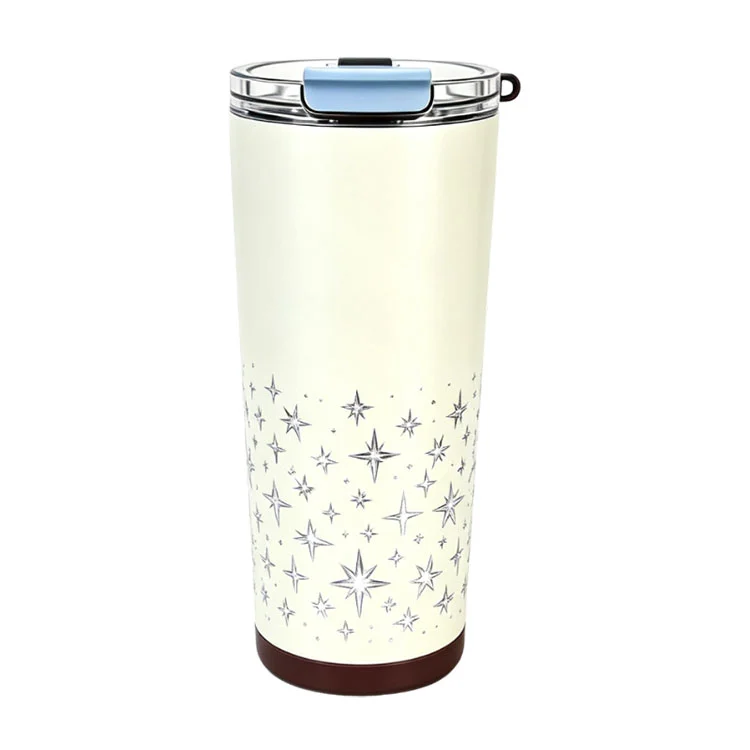
The Elma Tumbler Star Pattern combines double-wall vacuum insulation with a decorative exterior designed for everyday drinkware and gift collections. We developed this model around a practical 20oz/600ml capacity, making it suitable for coffee, iced Americano, tea, fruit drinks, and drinking water.
Its inner liner is made of 304 stainless steel, while the outer shell is also stainless steel. The double-wall vacuum structure helps maintain beverage temperature and reduces the temperature change on the external surface. When carrying iced drinks, this construction helps prevent the typical sweating problem associated with single-wall cups.
Product Specifications
| Specification | Elma Tumbler Star Pattern |
|---|---|
| Product Type | Vacuum Insulated Tumbler |
| Capacity | 20oz / 600ml |
| Inner Material | 304 Stainless Steel |
| Outer Material | Stainless Steel |
| Insulation Structure | Double Wall Vacuum Insulation |
| Lid Material | PP with Food-Grade Silicone Sealing Ring |
| Lid Design | Pop-Up Direct Drinking Lid with Side Hanging Ring |
| Surface Process | Heat Transfer Printing / Blank Sublimation |
| Available Styles | Star Pattern, Geometric Color Blocks, Vintage Floral Patterns, Plain Designs |
| Packaging | Individual White Box or Customized Gift Box |
Design Details for Everyday Use
- Decorative exterior: The milk-apricot base color and golden star pattern give the tumbler a distinctive retro appearance. Other available patterns include geometric blocks and vintage floral designs.
- Convenient drinking: The pop-up lid supports direct drinking, while the silicone sealing ring helps reduce splashing during daily carrying.
- Portable shape: Its slim body is designed for convenient handling and compatibility with many standard vehicle cup holders.
- Practical base: A non-slip bottom pad helps improve stability when the tumbler is placed on desks or other flat surfaces.
- Customizable appearance: Plain sublimation models can be customized through heat transfer printing, while logo engraving and customized packaging are also available.
For this model, we recommend hand washing rather than dishwasher cleaning. High-temperature washing and strong detergents may affect the printed surface over time. This is particularly important for decorative drinkware where pattern consistency is part of the product's value.
What Affects Vacuum Tumbler Performance?
Even with a double-wall vacuum structure, actual insulation performance can vary between products. In our experience, the following factors should be considered when evaluating a stainless steel travel mug.
1. Vacuum Integrity
The vacuum cavity must remain properly sealed. Poor sealing or damage to the vacuum structure can increase heat transfer between the two walls. Manufacturing inspection should therefore include checks related to vacuum integrity and thermal performance.
2. Lid and Opening Design
The vacuum layer protects the main body, but the drinking opening and lid remain potential heat-transfer paths. A properly fitted lid and silicone gasket help reduce splashing and limit heat exchange. However, the lid area may still become cool during extended use with iced beverages.
3. Ambient Temperature and Humidity
Condensation is influenced by the surrounding environment. In a humid room, even a small temperature difference can increase the possibility of moisture forming on exposed surfaces. A well-insulated tumbler reduces this risk but should not be described as completely condensation-proof under every environmental condition.
4. Physical Damage
Strong impacts or severe deformation may compromise the vacuum structure. If a tumbler suddenly loses its insulation performance or develops unusual exterior heating or cooling, it should be inspected rather than continuing to be used as normal.
How We Ensure Consistent Tumbler Quality at Kudike
At Kudike, our experience in stainless steel drinkware manufacturing comes from years of working with vacuum insulation, metal forming, and customized surface finishing. Since 2017, we have developed our production capabilities through Yongkang Jiangzhi Cup Industry Co., Ltd., with a focus on OEM and ODM drinkware manufacturing.
Our 10,000㎡ manufacturing facility has more than 200 skilled workers and automatic production lines, with a daily production capacity of over 30,000 units. This production scale allows us to support different product structures, appearance requirements, and order volumes.
Our manufacturing and customization capabilities include:
- Material selection: 304 and 316 stainless steel, as well as pure titanium options for different drinkware projects.
- Metal forming: Production processes for stainless steel bottles, tumblers, flasks, and mugs.
- Surface finishing: Powder coating, silk-screen printing, and laser engraving.
- Product customization: Logo application, color development, pattern design, and customized gift packaging.
- Quality management: Manufacturing systems supported by BSCI, ISO 9001, LFGB, and FDA-related certifications.
We have also worked with international brands including OPPO, BMW, Vivo, and Disney. These projects have helped us understand the importance of consistent production, appearance control, and delivery requirements in customized drinkware manufacturing.
Whether a project involves a decorative travel mug such as the Elma Tumbler Star Pattern or a customized stainless steel vacuum bottle, we consider material selection, structural design, surface finishing, and production consistency together. This approach helps us develop drinkware products that combine practical insulation performance with the appearance and branding requirements of different markets.
Explore our stainless steel drinkware collection or learn more about Kudike's manufacturing capabilities for OEM and ODM cooperation.
Frequently Asked Questions
1. Does a vacuum insulated tumbler completely prevent condensation?
A properly manufactured double-wall vacuum tumbler significantly reduces condensation on its outer body by limiting heat transfer from the surrounding air to the cold inner wall. However, moisture may still appear around the lid, drinking opening, or other exposed areas, especially in high-humidity environments.
2. Why does my stainless steel tumbler sweat even though it has two walls?
Not all double-wall tumblers use vacuum insulation. Some models have an ordinary air gap between the walls, which provides less effective thermal protection. If a vacuum-insulated tumbler starts sweating unexpectedly, damage or loss of vacuum integrity may also be a possible reason.
3. Can a vacuum insulated tumbler hold both hot and cold beverages?
Yes. The same double-wall vacuum structure reduces heat transfer in both directions. It helps slow heat loss from hot coffee and reduces heat gain when the tumbler contains iced water, tea, or cold juice.
4. Does the lid affect condensation and temperature retention?
Yes. The main body may have effective vacuum insulation, but the lid and drinking opening are not necessarily vacuum insulated. A well-fitted lid with a silicone gasket helps reduce splashing and heat exchange through the opening. It is normal for the lid area to behave differently from the insulated metal body.
5. How long can the Elma Tumbler Star Pattern keep drinks hot or cold?
The Elma Tumbler Star Pattern is designed with double-wall vacuum insulation. Its stated reference performance is approximately 6–8 hours for hot drinks and more than 12 hours for cold drinks. Actual results depend on initial beverage temperature, filling volume, ambient conditions, and how frequently the lid is opened. Standardized testing is recommended when comparing thermal performance between models.
6. Can Kudike customize the pattern and logo of the Elma Tumbler Star Pattern?
Yes. We support heat transfer printing, blank sublimation, laser logo engraving, and customized color boxes. Customers can select existing patterns or discuss new artwork and branding requirements for their drinkware projects.
7. Is the Elma Tumbler Star Pattern dishwasher safe?
We recommend hand washing this model. Dishwasher temperatures, water pressure, and detergents may gradually affect the heat-transfer printed pattern and exterior finish. Use warm water and mild detergent with a soft sponge to maintain its appearance.
8. What materials are available for Kudike's customized drinkware?
Our material options include 304 and 316 stainless steel and pure titanium. The appropriate material depends on the intended product structure, application, target market, and project requirements. We also support different surface finishes and customized packaging through our OEM/ODM services.